Seeds As Promise
On cold frames we don’t have, and the promises we make anyway.
It doesn’t actually begin with the flop of a small, soft package dropping onto the front door mat (and the hope that the contents are not already frozen, wet or otherwise traumatised from their journey), but days, even weeks, before this.
Decades ago, it began with the piling up of printed catalogues on the coffee table. Seed catalogues offering the promise of sowing and growing the garden of our dreams, together with a smug self-sufficiency. One supplier even had the audacity to post theirs the week after Christmas!
Now there are only a couple of physical catalogues (I have beef with one who simply will not stop sending them despite repeated requests), and the browsing begins online, for me, around the first week of January. When the decorations come down and the evenings are just that slightly bit longer.
I don’t miss the printed catalogues, if I’m honest, and the having to guess at most of the outcomes. Online there is room to see full biographies of every seed: what it will look like, where it will grow best, the optimum temperature for germination, what soil it needs, what should be its companions. How could we fail when nothing is left to chance?
And yet, half my seed sowings will.
It is all too easy to keep adding from the longlist to the online basket, telling yourself you’ll cut back this year, but the cart still resembles the weekly shop.
We delete the ornamentals that will take more effort than reward and decide we’ll buy them as plug plants instead. I will still end up with an impossibly long shortlist of things to grow to eat, and things to grow to admire. Why feel guilty if I’m growing my own? I mean, it’s the coldest and wettest stretch of January and February, I just want the hope of something growing, and something to tend.
Old favourites for tradition (Grandad always and only grew tomato ‘Moneymaker’) and some new varieties and things to try. Don’t I feel jazzy trying red spring onions or stripy beetroot? That said, my OH and I recently held what felt like an EU summit about whether or not to put time and resources in to growing tomatoes this year. Without a greenhouse, on the north Wales coast, we have - for the first time - decided against it. Sorry, Grandad.
My next seed order is due to arrive this week. The current state of play in the conservatory is that there is a tray of sweet peas, only half sprouted (I say this indignantly as they were from new seeds, though I neither chitted nor soaked); poppy seedlings desperate to escape their tray; a lemon tree ravaged by every pest and stripped of bark and leaves but still holding on; four teasels in pots (just be thankful I got around to potting them on, I’ll take a small win); three cornflowers and one campion in their small pots.
They have survived a combination of being forgotten, under-watered, over-watered, spilled onto, sown too sparsely and too densely, and been given smudged labels. Knowing I’m not relying on them to feed myself removes the jeopardy I suppose, but it also makes me think I can rush the whole process and get away with it.
The hardest part is still to come. Getting the growing soil into appropriate vessels and inside the house. I don’t have cold frames, greenhouses or polytunnels. It’s the highly fluctuating temperatures of window sills and floors in an unheated conservatory that must serve as temporary growing home and nursery.
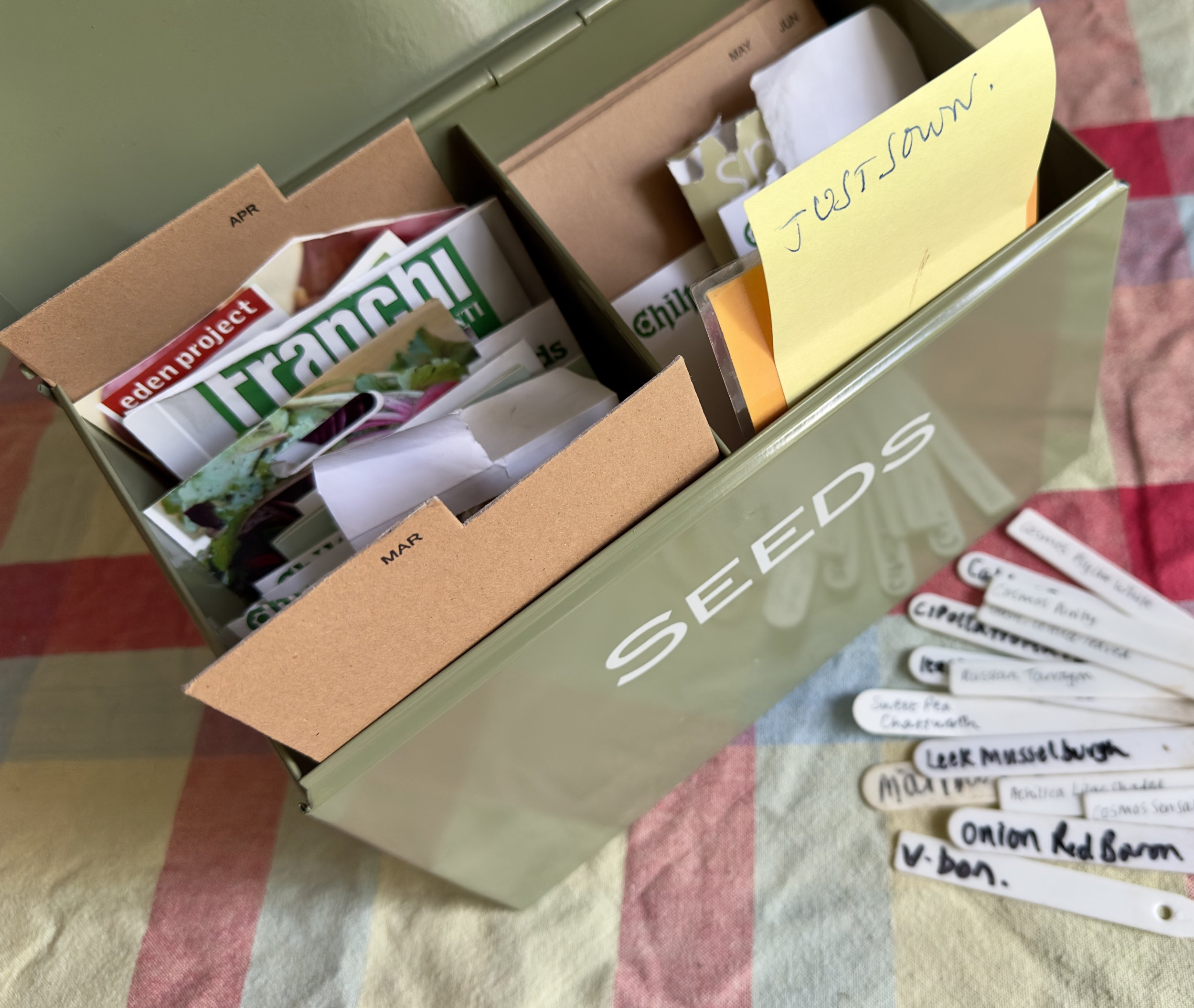
There are split plastic trays years old that I refuse to make refuse, cut-up drinks bottles, washed yoghurt pots, takeaway containers - but one thing is constant: labels and black marker pen.
Do not forget to label.
I resolve every year to be ready, to take my time and be orderly about it. The reality is usually selective swearing, losing the scissors at least twice, compost between my toes and smudged handwriting. The first label is always immaculate, standards slipping by the third.
As the seeds drop from hand to soil, I enter into an agreement with them. It takes courage from me and from them. We both hold a promise. One last breath, and the soil covers them.
They are pressed in without announcement to the universe. Then the daily talking and cajoling begins. The watching. The resistance to over-watering. The small gasps when a sprout pushes through, sometimes carrying a mound of soil above it, which somehow makes it even more remarkable.
Spring is not far away. Blossoms line the tree-lined roads of suburbia. Crocuses and daffodils are well underway. Meanwhile our working lives worship spring in their own way with new launches, new announcements, quarter-one growth charts.
But a tray of seedlings in pale February light is true delight.
Small.
Unimpressive.
Alive.